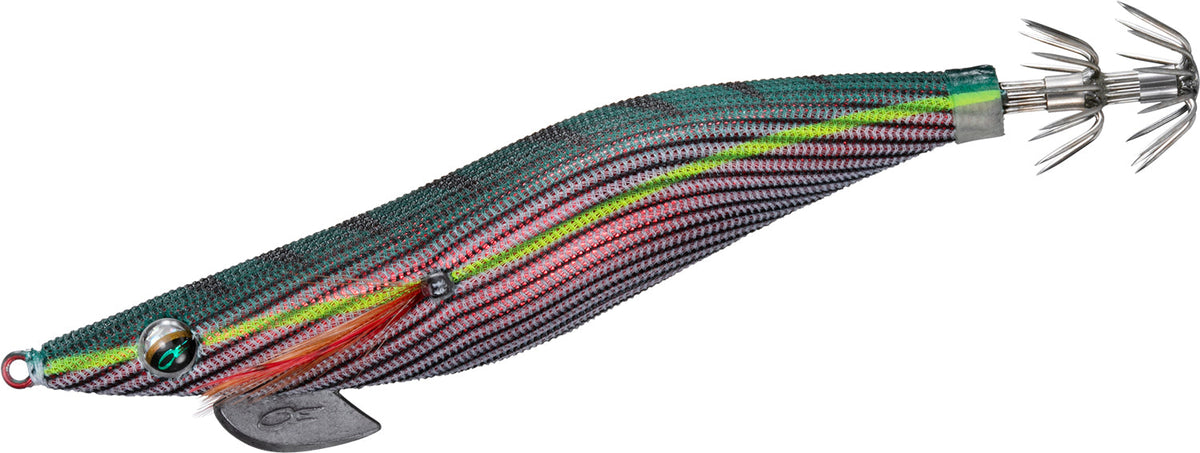
Short answer: if you only buy one egi, make it a size 3.0. Use 2.5 in shallow, clear or calm water, 3.5 in wind, current and deeper water, and 4.0 only for heavy current or big calamari. The number on the box controls how well the jig stays in the strike zone. It does not control the size of the squid you catch.
What the size number means
The number on a Japanese egi (1.8, 2.0, 2.5, 3.0, 3.5, 4.0) is a length in sun (寸), an old Japanese unit of about 3 cm. As a rough guide it is the body length, so a 3.0 has a body about 9 cm long. It is not a weight, and it does not tell you how fast the jig sinks.
In practice it changes control. A small jig hangs longer in the strike zone in calm, shallow water. A larger one holds its line against wind and current and casts further.
Which size for which conditions
| Size | Use it when | Notes |
|---|---|---|
| 1.8 to 2.0 | Very clear, very shallow water, or spooky and pressured squid | Finesse sizes. Poor in wind and on long casts. |
| 2.5 | Shallow reef, thick weed, calm clear water, small squid, pier lights | Extra hang time in the strike zone. |
| 3.0 | General pier, bay and reef work | The all-rounder. If you buy one jig, buy this. |
| 3.5 | Wind, moderate to strong current, deeper water, bigger squid | Longer casts and better contact with the lower half of the water. A slow-sink 3.5 gives you the big profile without the speed. |
| 4.0 | Strong tidal flow, deep water, heavy wind, big southern calamari | High piers over strong flow, kelp country and offshore. |
If you would rather work from the water: light or no current suits 1.8 to 2.5, moderate current suits 3.0, and strong current or heavy wind suits 3.5 to 4.0.
Sink rate matters as much as size
Japanese makers label sink rate separately from size. You will see codes such as SS or S (shallow, slow), standard, and D or R (deep, rapid). Most standard egi sink at roughly 3 to 4 seconds per metre. The Crono Prospec SSS, built for boat tip-run work, falls at about 11 seconds per metre, around three times slower. The Daiwa Emeraldas Amorous Joint 2.5 falls at about 4.75 seconds per metre.
Here is how that looks inside one range. These are the figures on our Yamashita EGI OH K listing:
| Size and type | Weight | Body length | Sink rate |
|---|---|---|---|
| 2.5 Basic | 11 g | 75 mm | about 5 s/m |
| 3.0 Basic | 16 g | 90 mm | about 3 s/m |
| 3.0S Shallow | 15 g | 90 mm | about 6 s/m |
| 3.0SS Super Shallow | 14.5 g | 90 mm | about 8 s/m |
| 3.5 Basic | 22 g | 105 mm | about 3 s/m |
| 4.0 Basic | 26 g | 120 mm | about 3 s/m |
The 2.5 sinks slower than the 3.0, and a 3.0S sinks at half the speed of a 3.0 Basic. Two jigs of the same size can fall at completely different speeds, so check the sink rate on the box or the product page before you assume anything from the size.
| Conditions | Sink rate to look for |
|---|---|
| Shallow reef, high weed, cautious squid | Slow or shallow. It keeps the jig above structure through the pause. |
| General pier work, mixed depth, moderate wind and flow | Standard. |
| Deeper water, strong current, hard wind | Fast or deep. It keeps you in control. |
| Boat vertical or tip-run under a sinker | Super slow (SSS). |
A three-jig starter kit
One 3.0 as the workhorse, one 2.5 for shallow or fussy squid, and one 3.5 for wind or depth. Add a 4.0 if you fish heavy current. After that, change colour rather than size: a natural for the day session and a glow for dusk and night. Our size and colour guide covers colour in detail.
The Yamashita EGI OH K is a good place to start for the 3.0 and 2.5. The Daiwa Emeraldas Dart LC is a long-cast, sharp-dart body when you need distance, and the EGI OH K Deep adds a heavier sinker for deeper water, wind and current. Browse them all in Squid Jigs.
Common questions
Does a bigger egi catch bigger squid?
Not by itself. A 3.0 catches large calamari. Bigger sizes help when wind or current make a smaller jig hard to control. Squid size is mostly about season and place.
Is 3.5 too big for Australian calamari?
No. A 3.5 is a standard choice for wind, current, deeper water and big calamari. Drop to 3.0 or 2.5 when the water is clear and shallow or the squid are small.
What size is best under pier lights?
Small squid under lights often take a 2.5. In wind or current a 3.0 or 3.5 holds better, and at night a mid-size jig usually beats a tiny one. Carry both.
How many jigs should I carry?
Six covers most days in a bay: natural in 2.5 and 3.0, a red foil, a dark-backed 3.5, a UV (keimura) finish and a glow.
Not sure which mix suits where you fish? Ask us before you buy, or start with the eging guide.

Leave a comment
This site is protected by hCaptcha and the hCaptcha Privacy Policy and Terms of Service apply.